 shibi sharkie
The short answer
During an eligible active call, send Sharkie a short private instruction about the next safe step. The note is routed to the assistant, not displayed to the caller as a message, but it can influence what the assistant says aloud.
Choose a public meeting point before a secret shortcut
A useful delivery instruction might be “use reception,” “wait by the front entrance,” or “ask which side of the building they are on.” Those details can solve an ordinary handoff without giving the caller a door code or an unrelated personal schedule.
The example is a fictional delivery situation. A caller claiming to have a parcel is not verified by that claim. If the conversation is unexpected or suspicious, do not treat a familiar-looking phone number as proof that it is safe to disclose access details.
Listen first if you need the current context
Open the eligible active call and choose Listen to hear the conversation with your microphone muted. Check what the caller already said, so your instruction does not ask for the same information again.
If the driver has already explained the entrance, a better note is a next step rather than “ask where they are” again. You are guiding a conversation already in progress, not resetting it to the greeting.
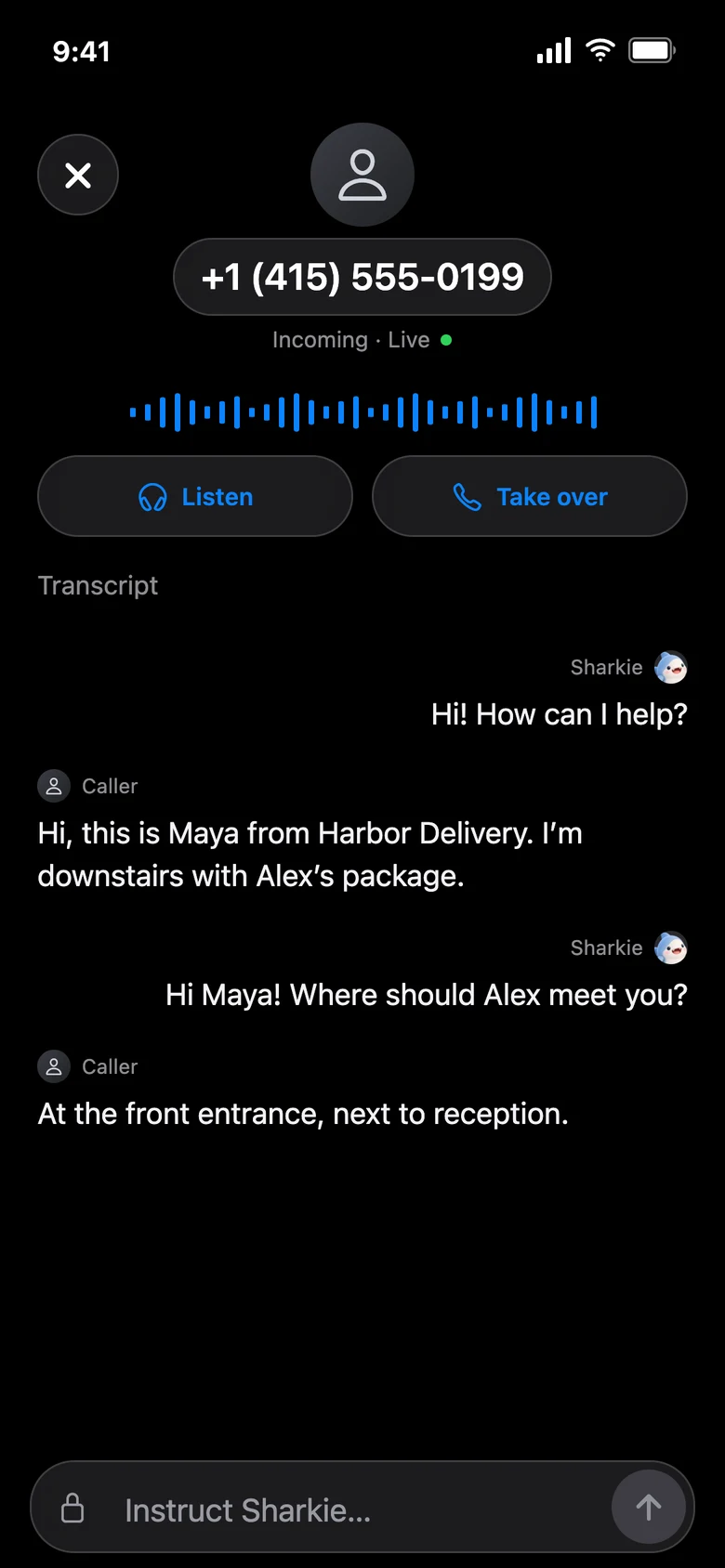
Send a concise instruction with a useful boundary
Fictional private instruction
“Ask them to leave the parcel with reception. If reception is closed, ask them to wait at the front entrance. Don’t give out an access code.”
Use the in-call instruction composer, not an assumption that an ordinary chat message is automatically applied to this call. The note is for a relevant next step; it does not change every future answering instruction or automatically create a permanent spam preference.
If the caller cannot follow the suggestion, the assistant should report or clarify that rather than claiming the parcel was delivered.
Private routing is not an absolute secrecy guarantee
The instruction is not shown to the caller as a chat bubble or deliberately read as a quoted owner note. Its purpose is to influence the assistant’s next response. That means some information you supply may become part of the spoken conversation.
Do not include a password, a one-time code, or information you would not want repeated accidentally. AI can misunderstand a boundary. “Do not say this secret” is not a sound reason to put an unnecessary secret into the message in the first place.
Take over when the decision is yours
If the situation needs your personal judgment, choose Take over while the supported call is still active. The assistant steps out, and AI-call recording stops before you take over. The controls depend on an enrolled supported device, permissions, and connectivity.
After the conversation, review what was actually said in Calls. “The driver agreed to try reception” is not the same as a confirmed handoff. Use the summary to find the detail, not to replace confirmation when it matters.