 shibi sharkie
The short answer
The displayed caller ID, a number spoken in the conversation, and a trusted official contact number are different pieces of information. Compare them; do not assume that any one of them verifies the caller.
Know which number you are looking at
- Displayed number: the caller ID associated with the incoming record.
- Spoken callback number: the number the caller asked you to use.
- Independently trusted contact: a number you obtained through the actual business or a contact you know.
These can legitimately differ, but a difference deserves attention. The FTC explains that caller ID can be spoofed; a matching-looking name or local area code is not identity verification.
Find the part of the conversation that contains the request
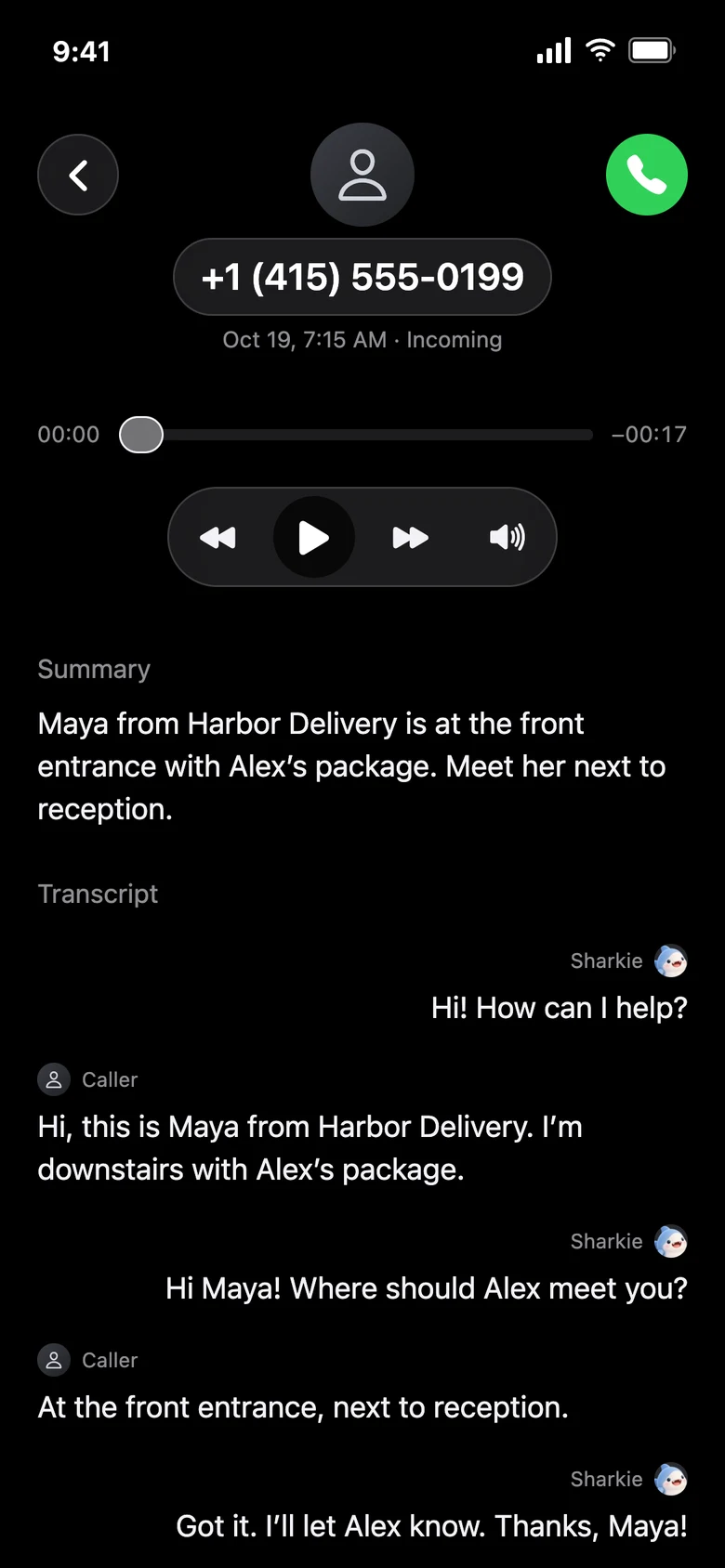
Open the call record and scan its transcript for the callback request. Check who said it: a caller’s statement is different from the assistant asking whether a number is correct. A partial or interrupted sentence may not establish the complete number.
If the caller simply said “call me back here,” the record’s displayed number may be the intended reference, but that still does not authenticate the person. If they supplied another number, do not silently substitute whichever one is easiest to find.
Use an available recording to resolve uncertain digits
Transcripts can mishear names, spoken digits, or email addresses. When a recording is available, move the playback position to the relevant part and listen. If it remains unclear, seek clarification through a trusted channel instead of guessing the missing digit.
Recording playback is not a permanent archive. Eligible AI-handled recordings are retained privately for up to 30 days and can be unavailable. A summary, transcript, and recording are separate: the presence of one does not guarantee the others exist. See Privacy for the current handling.
Important account requests need a trusted contact route
If the caller claims to represent an important account or asks for sensitive information, verify the contact independently. Do not rely on a callback number supplied by the same unexpected caller as your only check.
This is not a reason to classify every unfamiliar callback as spam. It is a reason to keep “the caller said this” separate from “I verified this.” Do not send passwords, one-time codes, or payment credentials to the assistant to pass along.
Only then ask for a precise personal follow-up
When the destination and purpose are clear, you can explicitly ask Sharkie to call the supported U.S. number and convey a bounded message. Use the complete confirmed number, or an unambiguous saved contact with the relevant permission.
Do not ask the assistant to infer an unknown recipient from a vague “call them” instruction. Check the actual result afterward; a completed call does not prove the other person heard or accepted the message. The current outgoing request and duration limits still apply.
If your real question is which calls deserve a response at all, start with the follow-up triage guide.